December 23, 2025
Software deadlines rarely slip because a team is “too slow.” They slip because the plan was missing reality: unclear scope, hidden dependencies, delayed decisions, and feedback that shows up after work is already built.
The good news is that most delays are predictable. If you can spot the patterns early and add a few guardrails, you can protect timelines without turning the project into a bureaucracy.
If you are planning a build, rebuilding a legacy platform, or trying to ship faster with fewer surprises, this is the playbook.
The real reason deadlines slip
Most “late” projects are not late because of effort. They are late because of rework.
Rework shows up when:
-
a feature is built, then rethought
-
an integration “should be easy,” until you hit authentication, data mapping, or rate limits
-
stakeholders first see the product after weeks of development
-
QA becomes a long phase instead of a steady routine
When timelines fail, it is usually because the project is discovering its real requirements mid-build instead of up front.
6 common causes of missed deadlines
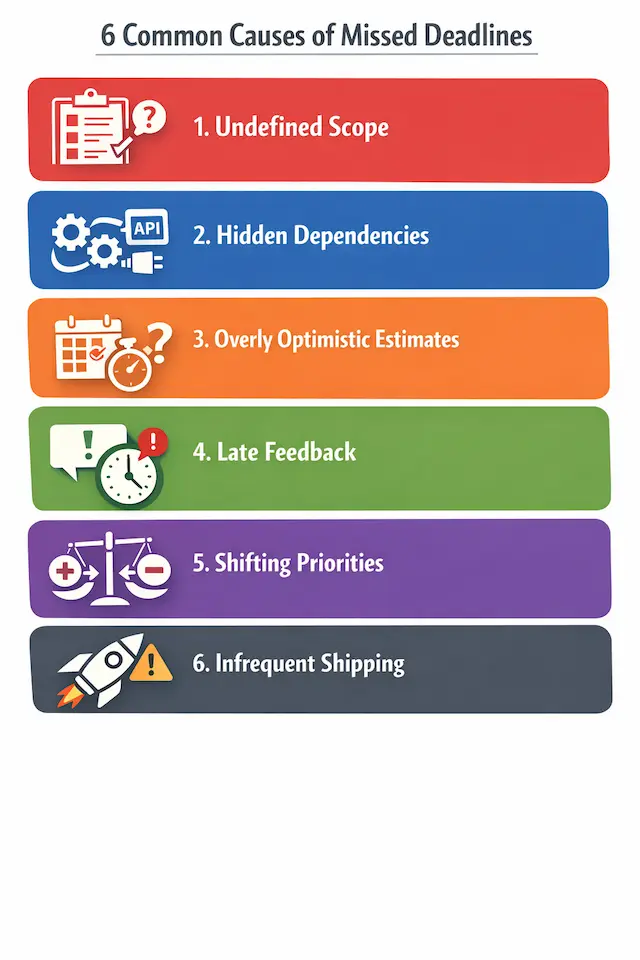
Most deadlines slip for the same handful of reasons. It usually is not a lack of effort, it is a lack of clarity. When scope is fuzzy, dependencies surface late, and feedback comes in after work is already built, the schedule turns into a rework cycle. The six causes below are the patterns we see most often, and they are also the easiest to prevent once you know what to look for.
1) Scope is not defined at the “done” level
A feature name is not a requirement.
“Build a dashboard” can mean:
-
a simple table view
-
role-based access
-
filters and saved views
-
exporting, scheduling, alerts, and audit logs
How to prevent it
Define “done” using acceptance criteria:
-
who uses it
-
what success looks like
-
what edge cases count
-
what is explicitly out of scope
If the project involves unique workflows, complex logic, or tight integrations, it often helps to align early on whether you need a purpose-built solution versus forcing a platform to behave like one. That is exactly what FYIN outlines in signs your business is ready for a custom .NET solution.
2) Dependencies are discovered mid-build
Dependencies are anything you do not fully control:
-
third-party APIs
-
internal systems (ERP, CRM, data warehouse)
-
vendor approval processes
-
security reviews
-
content inputs and legal review
Even “simple” integrations can stall when the team does not have test credentials, sample payloads, or clarity on where the source of truth lives.
How to prevent it
Create an integration inventory before development starts:
-
what systems are involved
-
who owns each one
-
what data moves in and out
-
how failures are handled
-
what access is required and when
If your project touches core business systems, it is worth thinking in terms of real integration workstreams like ERP integration services and CRM integration services, not as “small tasks” buried in a sprint.
3) Estimation is treated like a promise
A single date feels clean. It is also fragile.
Estimates are forecasts based on assumptions. When assumptions change, the forecast changes too. The problem is not the estimate, it is pretending there is no uncertainty.
How to prevent it
Use ranges and confidence:
-
“2 to 3 weeks, high confidence”
-
“4 to 6 weeks, medium confidence due to vendor API”
-
“unknown until we complete discovery for integration X”
If budget or engagement model is part of the timeline conversation, pointing stakeholders to a transparent baseline like our standard rates can reduce late-stage friction and decision delays.
4) Feedback arrives too late
When stakeholders only see work near the end, they react to the finished version instead of shaping the right version.
Late feedback causes redesigns, scope changes, and technical pivots that ripple through the build.
How to prevent it
Create a weekly feedback loop:
-
a short demo every week
-
a defined decision maker
-
feedback within 48 hours
-
a simple decision log for major calls
5) Priorities change without tradeoffs
Teams often say “yes” to new priorities and quietly keep the old scope too. That is how timelines break.
How to prevent it
Adopt a simple tradeoff rule:
-
if something new is added, something else moves to the next milestone
-
if a deadline is fixed, scope becomes the variable
-
if scope is fixed, the deadline becomes the variable
This is not about rigidity. It is about making the cost of change visible.
6) Shipping is not routine
Projects that ship in one big release tend to have more unknowns:
-
long QA cycles
-
late performance issues
-
risky deployments
-
large batches of changes to debug
How to prevent it
Ship smaller slices more often:
-
release early value
-
validate real workflows
-
reduce the blast radius of change
-
catch issues while they are still cheap
This approach is especially useful when modernizing older systems. FYIN lays out a practical path in modernizing legacy .NET apps without a rewrite.
A prevention plan that works on almost any build
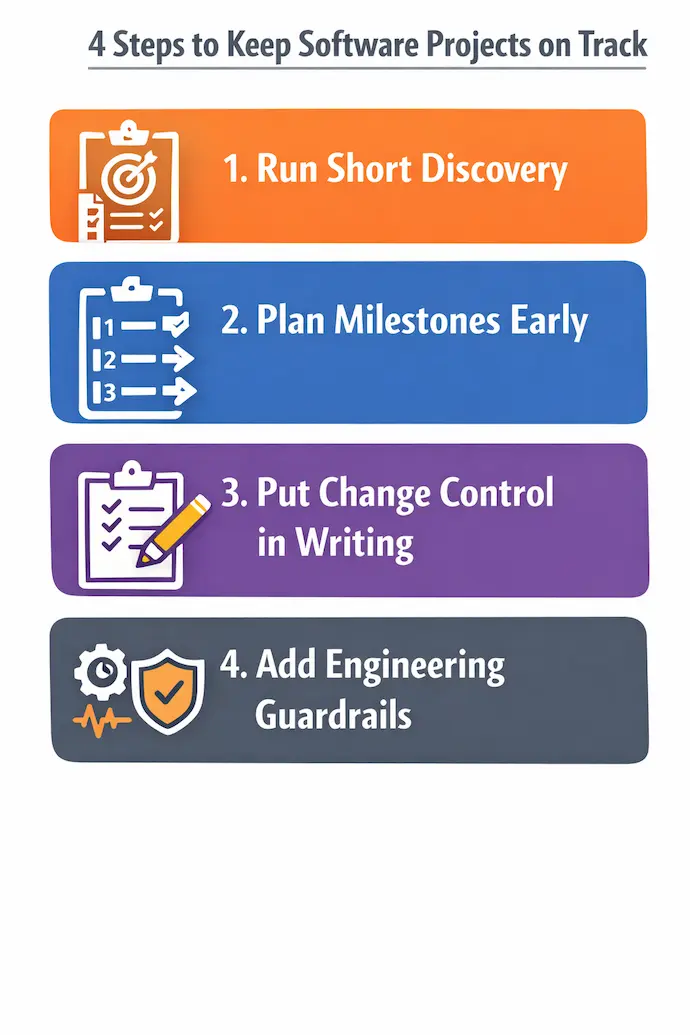
Step 1) Run a short discovery that forces clarity
You do not need months of analysis. You do need alignment.
In a focused discovery, lock down:
-
goals and success metrics
-
users and roles
-
workflows (happy path and exceptions)
-
systems and integrations
-
constraints (security, compliance, hosting)
-
what is out of scope
If stakeholders are asking “why does this take time?” it helps to frame discovery as an explicit value driver. FYIN breaks that down well in what custom software really costs (and why it’s worth it).
Step 2) Plan milestones that ship value early
Instead of one big timeline, build a sequence:
Milestone 1: A usable slice
-
core workflow
-
real users can complete a real task
Milestone 2: Integrations and operational workflows
-
connect systems
-
handle exceptions
-
improve admin tooling
Milestone 3: Hardening and scale
-
performance
-
security tightening
-
automation and monitoring
This reduces surprises because value is validated continuously, not at the end.
Step 3) Put change control in writing
This can be lightweight. Define:
-
how change requests are introduced
-
how impact is assessed (time, cost, scope)
-
who approves
-
how decisions are recorded
On larger sites and platforms, governance becomes the difference between “steady shipping” and design/process chaos. FYIN touches on how drift happens over time in designing for scale across hundreds of pages, and the same principle applies to product delivery too.
Step 4) Add a few engineering guardrails
These habits prevent last-minute chaos:
-
automated checks on every pull request
-
targeted tests for core workflows
-
feature flags for risky changes
-
clean environments and deployment routines
-
monitoring so failures are caught fast
If your team is building on Microsoft’s ecosystem, you can also point to why the stack remains reliable for complex, high-traffic business systems, as explained in why enterprises still rely on .NET.
What FYIN does differently to keep timelines on track
Most missed deadlines come down to predictable gaps: unclear scope, late feedback, hidden dependencies, and unmanaged change.
FYIN’s approach is built around clarity and repeatable delivery, whether that is through software engineering services, a build grounded in custom .NET development, or a broader delivery partnership across FYIN’s services.
If you want a feel for the types of systems and teams FYIN supports, you can browse recent work and see how solutions are structured in the real world.
For organizations that have outgrown off-the-shelf tools but still need predictable delivery, FYIN also breaks down the “why now” moment in why more mid-market companies are investing in custom development.
Let's talk about your project!
Book a call with us and see how we can bring your vision to life!